
The University of Andorra (UdA) is a higher education institution committed to ensuring that all individuals have the right to access, participate in, and be active members of the university community. This commitment is framed within the principles established in various normative instruments, including the United Nations Convention on the Rights of Persons with Disabilities, from which derives the exemption from tuition and academic fees for persons with disabilities in UdA official studies; Law 24/2025 of 13 November on Universal Accessibility; and the Government of Andorra’s Comprehensive Mental Health and Addiction Plan (2022).
UdA promotes a society based on equal opportunities, where all individuals, including those with disabilities or in vulnerable situations, can fully participate in their learning processes under conditions of equity and dignity. Within this framework, the University ensures personalized academic follow-up for students and the effective inclusion of all members of the university community.
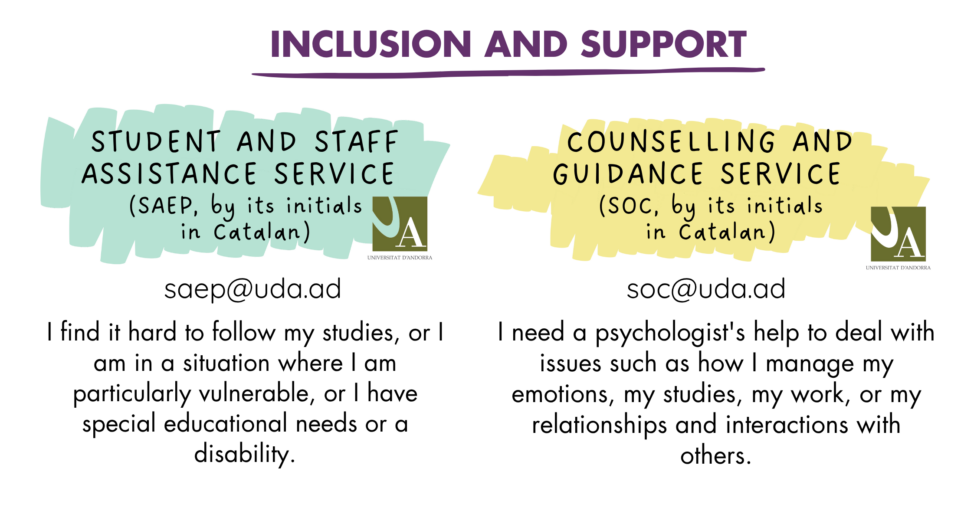
To implement this commitment, UdA has established an Inclusivity Plan and two dedicated services: the Student and Staff Assistance Service (SAEP, from Catalan acronyms: Servei d’Acompanyament a l’Estudiant i al Personal) and the Counselling and Guidance Service (SOC, from Catalan acronyms: Servei d’Orientació i Coaching). These services provide assistance and accommodations to members of the university community, addressing diverse situations related to Special Educational Needs or Disabilities (SEND) as well as other access or support requirements that may arise in academic and professional contexts. Support measures are structured across six main areas, depending on whether the individual’s needs are temporary or permanent:
- Support for individuals with Special Educational Needs (SEN).
- Support for individuals in vulnerable socioeconomic and sociocultural situations.
- Support for individuals requiring psychological guidance.
- Support for individuals with difficulties managing intra- and interpersonal relationships.
- Support for foreign students with SEND.
- Support for health and occupational safety issues.
In the area of universal accessibility, the SAEP collaborates with other institutions to promote access, participation and retention within the UdA university community. As part of this commitment, members of the university community who require extensive or complex support with personal hygiene can use the LAUesport inclusive changing facility. This 15 m² accessible facility is equipped with a range of support features, including a toilet, sink, shower, hoist and changing table. The facility is located in Plaça de Calonge-Sant Antoni, Sant Julià de Lòria. To use it, you must book it by contacting saep@uda.ad.
What is SAEP?
The SAEP is a guidance service for the entire university community. It offers support and accompaniment to facilitate the inclusion of students with Special Educational Needs or Disabilities (SEND) and staff members. It provides support in various situations that may hinder or prevent the continuation of their academic and/or professional activities, acting as a link between the user and available support services at the University and within the country.
Target groups include:
- Students with Special Educational Needs (SEN) or staff with needs such as: specific learning disorders (dyslexia, dyscalculia, etc.); behavioral disorders; attention deficit disorder; hyperactivity; communication disorders; autism spectrum disorders; and other mental health–related disorders.
- Students or staff with disabilities: anyone with physical, intellectual, or sensory disabilities, or those living with degenerative or rare illnesses.
- Students or staff with socioeconomic or sociocultural needs, or those at risk of social exclusion or vulnerability.
What does SAEP offer?
- Personalized support through scheduled interviews with an expert.
- Academic resources for both in-person and virtual classroom activities.
- Resources that improve quality of life and promote autonomy.
- Personalized support measures to help achieve the competencies required to obtain official degrees (DPA, bachelor’s, master’s, and doctoral programs). These measures do not modify the academic standards of the programs.
- Support for faculty in implementing agreed-upon measures for students.
What kind of support is offered to the student?
Teaching
- Accessible texts: documents adapted with appropriate font type and size, well-defined spacing, and clear graphics.
- Extended deadlines: additional time for completing academic work.
- Specific tutoring: individualized support sessions with a tutor.
- Technical support.
Exams
- Accessible texts: exams with adapted font, clear spacing, and graphics.
- Extended time: an additional 25% of the allotted time to complete the exam.
- Exam reading: initial reading to ensure understanding of instructions.
- Accessible spaces: rooms accessible to students with reduced mobility.
- Separate room: option to take exams in an isolated room.
- Reserved seating: assignment of a specific seat in the classroom.
- Technical resources: use of adapted software, computers, etc.
How to request SAEP service?
Interested individuals can contact SAEP through:
- In person: at the office of SAEP coordinator, Ingrid Blanc, or the office of the relevant study program coordinator.
- By phone: +376 743 000, requesting one of the above contacts.
- By email: saep@uda.ad.
SAEP will schedule an interview with the student to design, if appropriate, personalized support measures. It is recommended to contact SAEP before the start of the course or semester. In cases of unforeseen need after the program has begun, support measures can be requested throughout the academic year.
What documents should be brought to the meeting?
Applicants must bring updated medical documentation verifying their situation and, if applicable, the support measures they require.
- For disability of 33% or more: updated certificate from the National Assessment Commission (CONAVA).
- For less than 33%: medical report from a specialist or report issued by social services.
What is SOC?
The SOC is available to the entire university community to promote emotional well-being. It provides psychological support, academic guidance and coaching. It also addresses issues related to emotional stability, academic or work performance, and interpersonal and intrapersonal relationships. This free service offers up to three hours of support per academic year per person, scheduled according to mutual agreement between SOC and the user.
What does SOC offer?
- Psychological guidance and support.
- Coaching and mediation in personal, academic and professional contexts.
- Assistance during moments of anxiety, distress, or stress, and early detection of potential depressive symptoms.
- Referral to specialized professionals in cases of psychological distress with somatic symptoms, anxiety or depressive disorders, chronic illnesses, or any situation requiring specialized psychological follow-up.
How to contact SOC?
- By email: soc@uda.ad.
For more information, you can consult the University of Andorra’s Inclusivity Plan or contact the SAEP directly at: saep@uda.ad.